Author Archives: Patrick Lowenthal

Blackboard 9.0 — Is it time to upgrade?

At the University of Colorado Denver, we use two Learning Management Systems (LMS): eCollege and Blackboard.  There is a long history why we use two different systems and for better or for worse it doesn’t look like this is going to change any time soon.

Therefore, we have begun thinking about when we will upgrade from version 8 of Blackboard to version 9. Version 9 has a ton of new features that people seem to love.  But we have realized over the years at CU Online that stability in many ways is a better characteristic of a LMS than any specific feature.

We only have 1-2 times each year to upgrade Blackboard. And a great deal of thought and planning needs to be done well in advance before upgrading our LMS. Thus, we wanted to get an idea of what others — specifically those who upgraded from version 8 to version 9 — think of version 9.

I created a basic Google Docs survey that I sent out to Blackboard Admin listserv. The survey included the following questions:

1a. If you are using Blackboard 9.0, are you happy with it compared to Blackboard 8.0?

1b. If you would like (though it isn’t needed), please explain why you like or dislike it in comparison to Blackboard 8.0

2a. Assuming you are currently using Blackboard 9.0, based on your experience, which of the following would you recommend (keeping in mind that you aren’t aware of our circumstances)?

2b. If you would like (though it isn’t needed), please explain  your previous answer.

3. Is there anything else you would like to add?

The results can be found here:
http://spreadsheets.google.com/pub?key=0Ak6yjEoIPaTIdGRmY1FuTlZVUmJIekFUZklPdkNINlE&gid=0

So what did we find out? Well the majority of people were happy with Blackboard 9 and recommended upgrading but

Here are two graphs to illustrate the basic responses.

Using Twitter and other Social Networking Tools in the Classroom

Joni Dunlap and I presented about our instructional uses of Twitter in the classroom at EDUCAUSE 2009. Our PowerPoint slides from that session can be viewed online.

These slides alone however don't capture the story we told at our presentation. Luckily, after doing some networking, I got an opportunity to talk to the editor of EDUCAUSE Quarterly (EQ) who mentioned that she was looking for an article for the next issue of EQ focused on Twitter. That was all the motivation Joni and I needed. We ended up writing Horton Hears a Tweet and it was published in the December of 2009 in EQ. If you get a chance, give it a read. We focus on the reasons why someone might use social networking in general and about our personal experience using Twitter. Give a read or even better, give it a tweet.

Dunlap, J. C., & Lowenthal, P. R. (2009). Horton hears a tweet. EDUCAUSE Quarterly, 32(4).

Examples of Educational Websites

Teaching students how to design and develop Web-based learning environments (or what we call “EdWebs” at the Information and Learning Technology program at the University of Colorado Denver) can be challenging. Students typically begin the program with a wide range of previous experience with Web development. Some have been developing Web pages for years while others have no prior experience with Web development.

Especially those new to Web development struggle with meeting their own expectations to develop beautiful award winning style Web sites. The reality though (in my experience) is that while it is important to design aesthetically pleasing Web-based learning environments, a good and asthetically pleasing EdWeb does not need to be that complicated.

The following are some examples of different types of EdWebs to help give people and idea of the genre of Web-based learning environments or at least the “typical” self-paced Web-based learning environment. If you click on the image, you will either see a screen shot of the EdWeb (which is essentially all you need to get an idea of the overall look and feel) or in some cases you will go directly to the EdWeb.

Americans with Disabilities Act Course

Developed by CITT

EdWeb2
Navigation & the Healthcare System Course

Developed by CITT

EdWeb1Pic
HIPAA Regulations Course

Developed by CITT

EdWeb3
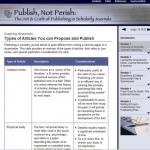
Publish, Not Perrish Course

Developed by CITT

EdWeb4
Successful Supervision in the Classified System Course

Developed by CITT

EdWeb5
Procurement Card Cardholder Training

Developed by CITT

EdWeb6
Using Gantt Charts

Developed by William Horton Consulting

EdWeb7
Welcome to Designing Electronic Courses
Developed by William Horton Consulting
EdWeb8
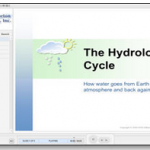
The Hyrdologic Cycle (Articulate Course)
Developed by William Horton Consulting
EdWeb9
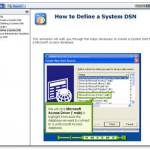
How to Define a System DSN
Developed by William Horton Consulting
EdWeb10
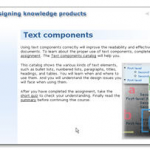
Text Components
Developed by William Horton Consulting
EdWeb11
How to Build a Course Website
Developed by William Horton Consulting
EdWeb13

The Labels We Use and Why They Matter

Brent Wilson and I wrote a paper in 2008 about AECT’s redefinition of the field. It was originally supposed to be included in the definition and terminology issue of TechTrends. However, due to a mix up, it was not included in that issue.  But it is finally published now online (at Springer) and is included in the Jan/Feb 2010 issue of TechTrends. A pre-print of the article can be accessed online.

Abstract of the article:
AECT has recently (yet again!) redefined our field, reverting back to the use of the term educational technology. We believe this recent change is problematic for a number of reasons, but primarily because of the weak rationale offered for the change. This change affects how external audiences view our profession and is likely to confuse practitioners in corporate and higher education settings in particular. We offer a review of job postings, program titles, and listserv discussions to support our case. The labels we use to define ourselves are critically important – and we hope to see a stronger case made for changes for our foundational definitions in the future.

I have a history of focusing on how language effects the things we do–from my Master’s thesis in religion that focused on how the language of the time shaped China’s reception of Buddhism to papers presented at AERA 2009 and AECT 2009 that focused on how online discourse  communities are shaped by the language we use. While a totally different focus, John W. White and I published a paper on the language used in educational reform.  This article can be accessed at the eJournal of Educational Policy. We have another article under review which focuses on academic literacy.

Lessons Learned Presenting at Conferences

I am a strong believer in attending and presenting at conferences for professional development.  Each year I try to attend the annual meeting of the American Educational Research Association (AERA) —http://www.aera.net/AnnualMeeting.htm — as well as the annual meeting of the Association for Educational Communications and Technology (AECT) — http://www.aect.org/events/.

As a side note, in addition, whenever possible I also attend ISTE’s — http://center.uoregon.edu/ISTE/2010/ — Sloan-C’s — http://www.sloanconsortium.org/aln — and EDUCAUSE’s —http://net.educause.edu/ConferencesSeminarsandInstitutes/31 — conferences to name a few.

So when I plan to attend a conference, I strive whenever possible to also present at the conference.  Often, I will even try to present more than once.

Well this last fall I went a little overboard and during basically a three week stretch I presented  11 times at three different conferences (two of the presentations though involved two parts so it was actually only 9 different sessions).  To be fair, when I originally completed the conference proposals, I never expected to have them all accepted. But through this process I learned a few things that I will take with me moving forward:

1. Never present more than 3 times — ideally strive for only 2 presentations — at a conference.
I enjoy attending sessions as much as I do presenting at sessions but I found that when I attend a conference where I present more than 2-3 times, I rarely attend that many sessions because I am spending most of my time preparing for my own sessions. Also, be prepared that they might accept any and all proposals you submit so think twice before sending in a bunch of different proposals.  If you want to present 2-3 times, only send in 3-4 proposals (assuming at least one will not be approved).

2. Always bring business cards to each session.

3. Find the room you are planned to present in.
Checkout the room you plan to present in before your session to get an idea of the location, room size, layout, Internet access… to name a few. During EDUCAUSE 09 I spent over 30 minutes trying to locate the room where the poster sessions were being held.  I barely found it in time to put up my poster before the session began.

4. Show Up Early.
Be sure to show up at the room earlier enough right before your session to ensure that such things as an LCD projector are  there.   At AECT, the hotel would remove the LCD projectors at the end of the day which meant that the first sessions each day often began with a rush to locate an LCD projector.

5. Create Handouts.
See Tufte’s work about this — or check out  Improving the Design of PowerPoint Presentations or a Review of the Cognitive Style of PowerPoint — but avoid giving copies of your slides as handouts.  If you want to give a handout (and I recommend it), then create a handout–ideally no longer than one page (front and back).

6. Determine the how many handouts you need.
Ask people who have presented in the past and/or the conference staff how many people typically attend each session so that you can have the right number of handouts. Most presentations, in my experience, tend to have 10-15 attendees. Therefore, you are often safe with 20-25 handouts.  However, during my last three week conference stretch, I had one session with over 75 people in it and another with about 35.

6. Post the slides online.
While I am not a fan of handing out my PowerPoint slides as handouts, I do try to post my slides online so others (both who attend the conference and those who didn’t) can access my slides.  But rather than giving out some long URL (e.g., http://www.slideshare.net/plowenthal/educause-2009-tweeting-the-night-away-using-twitter-to-enhance-social-presence) or even using a tinyurl (e.g., http://tinyurl.com/ybjepyr)  which might confuse people, simply point them to a Webpage with all of your presentations (e.g., http://www.slideshare.net/plowenthal).

7. Avoid traveling on a day you present.
This might be silly but try to avoid this if possible. At AECT this past fall I had to present on Halloween but I really wanted to get home in time to trick or treat with my kids.  I carefully picked my flight to help make this all happen but guess what…  my flight was delayed.

I am sure I am forgetting a few things but this list is a start.